
Deja Vu

As I sat down to pen these pages, I could not escape the feeling that we have been here before. Tomorrow we will receive the non-farm payroll report for July. Anybody remember what happened the last time we received non-farm payrolls for July just prior to an U.S. election cycle? If you don’t remember it was a shocker of a report, with jobs added coming in far below market expectations.

US hiring slowed markedly in July and the unemployment rate rose to an almost three-year high, raising recession concerns and putting the Federal Reserve solidly on a path to cutting interest rates in September.
Nonfarm payrolls rose by 114,000 — one of the weakest prints since the pandemic — and job growth was revised lower in the prior two months. The unemployment rate unexpectedly climbed for a fourth month to 4.3%, triggering a closely watched recession indicator and hammering stocks.
The markets would further be roiled by a kerfuffle in the global stock and bond markets largely attributed to an unwind of the yen carry trade. The yen carry trade, “defined broadly as using a low-yielding yen to buy higher-yielding foreign assets” can be “traced back to 1999 when Japan struck policy rates down to zero after its asset price bubble burst.” Japan became the “world’s biggest creditor nation” while its citizens sought out yield in the international markets to “get anything better than the zero yields at home.” When rates began to rise in the United States in 2022 and 2023, these positions grew to be quite large. So, when the Bank of Japan ended its negative interest rate policy and began to raise rates, “traders rushed to repay their yen-denominated borrowings.”

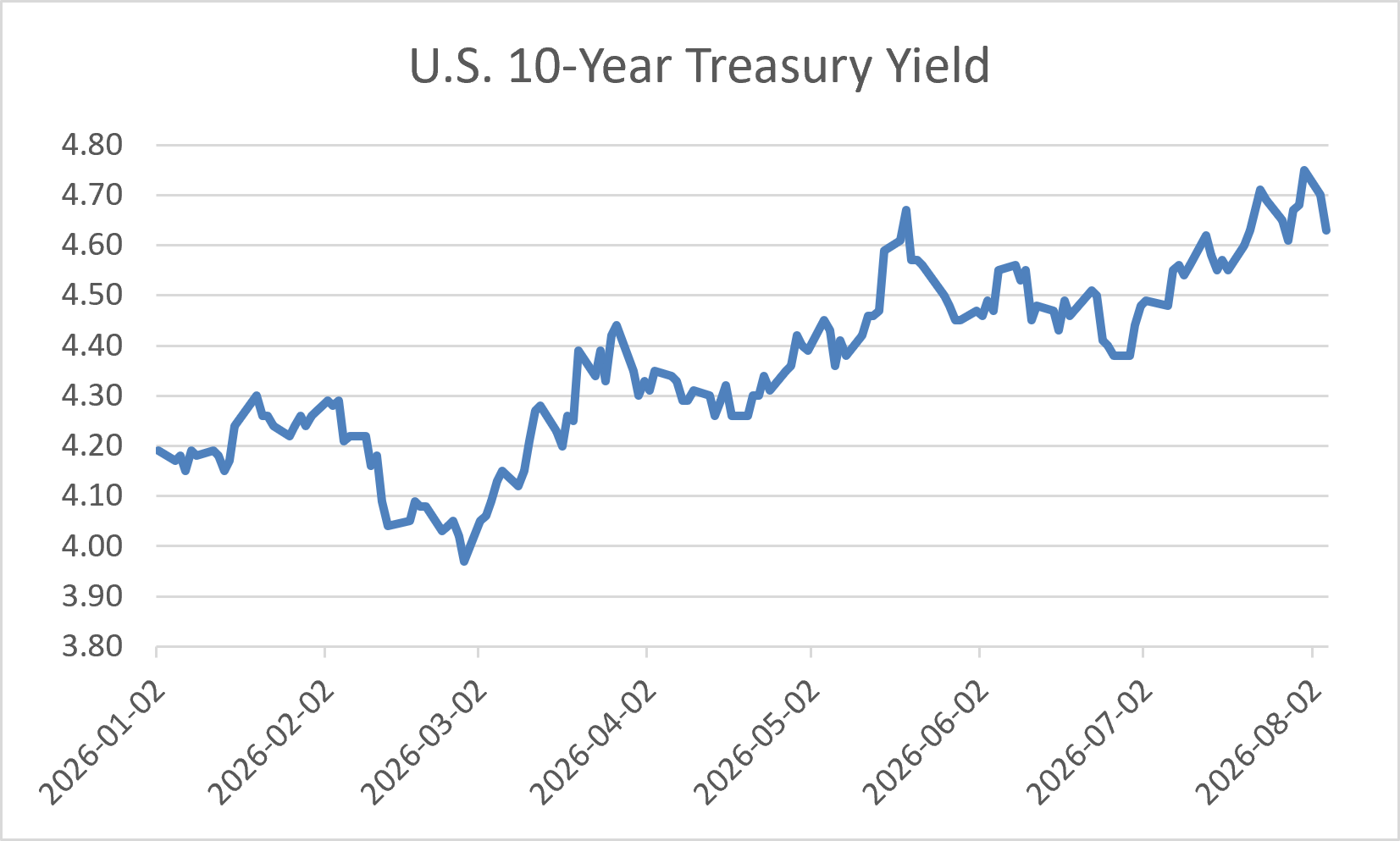
Old news, right? If you have been following along at home with financial markets, you may know already that the United States recently made the decision to “intervene” in the Japanese currency market after the yen fell to its weakest level “against a basket of trading partners and adjusted for inflation in data going back to 1970. Japan, which imports most of its energy, is facing a double whammy of the higher oil prices that affect everyone and even higher prices in yen terms as the currency plumbed new depths.” Why would the U.S. do such a thing? Japan provides a good deal of capital to the U.S. financial markets and is the largest holder of U.S. treasury securities. What the U.S. cannot afford at the moment is for Japan to start selling those treasuries to support its currency which would cause interest rates to rise even further.
Source: FRED
Long-time subscribers know that the 30-year mortgage rate actually tracks the 10-year treasury as mortgages on average have a shelf-life of about seven years. As yields on the 10-year rise, so do mortgage rates. As I’ve often discussed, the spread between the two can vary for a variety of complicated reasons, but rising yields invariably mean rising mortgage rates. A rising yield on the 10-year isn’t just bad for housing, though. It’s bad for just about everyone who has to borrow money, be it businesses or consumers. And, there’s a heck of a lot of money being borrowed at the moment. From hyperscalers to stock market gamblers, leverage looms large in the system.
U.S. margin debt, or what investors borrow from their brokerages to buy securities, rose 54% to a record $1.4 trillion in May from a year earlier, according to Finra data. Meanwhile, high-risk leveraged exchange-traded funds that produce double or triple the daily move of underlying stocks are growing rapidly, as is trading in options tied to them.
The U.S. government also cannot afford higher interest rates as they need to rollover trillions in debt this year.
I realized when I published last week that I was probably one of the few analysts not talking about what the Fed might do. You see, after the turmoil in the market in August 2024, the Fed would cut the Effective Federal Funds Rate by 50-basis points (bps) in September. The 10-year and mortgage rates were unimpressed.
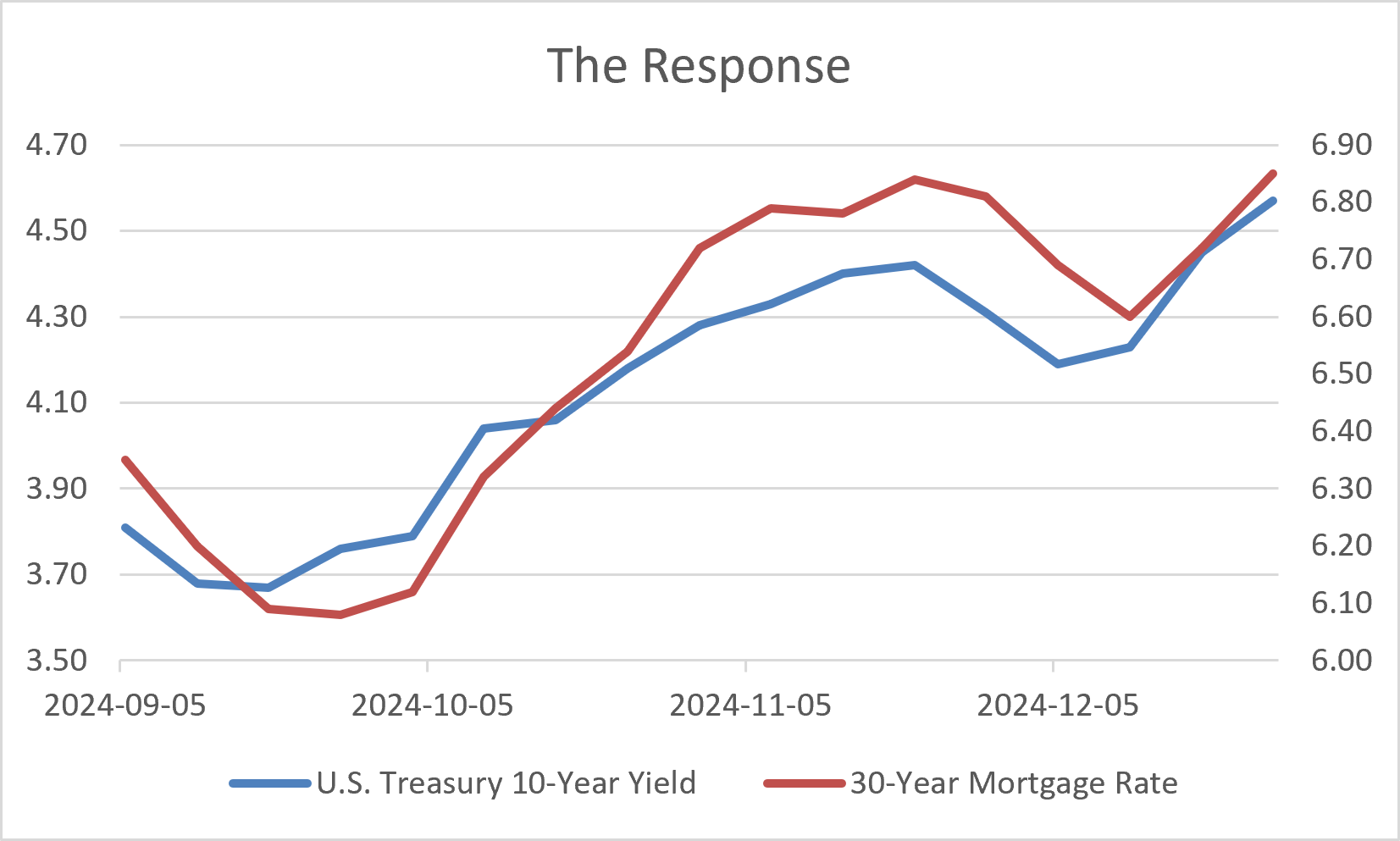
At the time, I watched everyone in the mortgage industry who had promised Fed rate cuts would be the answer become apoplectic. I’d personally been pushing back on that narrative since 2022 due to our new geopolitical realities post the war in Ukraine and also due to who holds our foreign debt. Every time I brought this up to housing pundits I was ignored.
I’m not arguing that the Fed’s actions are unimportant. Their actions are important precisely because of the way the larger market perceives those actions. For our purposes, I personally pay way more attention to the bond market, and I could tell based on its behavior that at a minimum, mortgage rates were not going to drop precipitously no matter what the Fed did. Indeed, they did not. Instead, yields and mortgage rates went higher.
After the Fed made that rate cut in September 2024, some analysts later came to believe that the move was politically motivated, and perhaps it was. Tomorrow’s setup seems similar in that whatever happens with the jobs report could pave the way for a “political” action/inaction just before the midterms. Bloomberg published an article yesterday arguing that it looks as if we have side-stepped fall-out from the joint US/Japan intervention as traders have moved to tap other currencies instead of the yen to effect the carry-trade strategy.

The muted response has eased fears of a repeat of the 2024 blowup, and shows that investors have diversified away from the yen, tapping currencies such as the euro and the Swiss franc to finance purchases of high-yielding assets in emerging markets.
No one really knows though. There is no definitive source out there that tells us how big or how small the yen carry trade really is. What we do know based on what transpired in August of 2024 is that a macro surprise can cause a sudden and violent reaction in markets. Another article on the topic from the WSJ argues that while the yen carry trade “should have become less attractive as policy rates converged, strengthening the currency,” traders instead shifted their focus to “2-year bond yields, where the gap widened a bit this year amid a cautious tone from the BOJ and expectations of Fed rate rises.” So, is it that traders are using other currencies or that the yen carry trade has taken on a slightly different flavor or that we just haven’t hit the right speed bump to see fallout?
The author of the aforementioned WSJ article also posits that in essence the intervention will serve as QE-lite and an injection of liquidity into already frothy markets. A former Fed employee, Jill Cetina, concurs.
Use of Fed facilities to fund sustained Japanese fx intervention in a material way would see the Fed’s balance sheet grow (QE-lite) and ease US financial conditions. Easing US financial conditions would be inconsistent with the FOMC’s stated goal to return elevated US inflation back to target.
If your head is spinning, or you have fallen asleep, then my point has been made. We keep plugging holes with any and every available tool to avoid the inevitable. If you study these cycles, you know that eventually the water crests over the dam. After ADP came in light yesterday, some analysts believe that tomorrow’s jobs report could be disappointing. Are we setting up for Fireworks Friday? Or will it be another boring August Friday as traders head to the Hamptons?
Your guess is as good as mine. What I do know is that with each passing day the system becomes more fragile. In mortgage specifically, after being a long holdout in the credit market, the floodwaters are now coming fast and furious with foreclosure starts (mortgage has just been referred to foreclosure) up 39.69% YoY in June. You may be thinking that we’ve held on this long so why couldn’t we hold on just a wee bit longer? There have been no meaningful moves to prevent what happens next in mortgage and housing. Housing is a very big deal to the economy, and the idea of “home equity” is one of the largest contributors to the wealth effect. I’ve long argued that when the big orange (ironic) below hits the skids, it will indeed be Hammer Time!

Not only is mortgage delinquency rising, but what happens when those who were dating the rate realize they are actually already married? In a recent report by Truework who surveyed homeowners who had purchased in the last 24 months, they found that “85% of recent homebuyers with a mortgage said refinancing within the next three years is important to their financial health. That’s up from 56% in a similar 2025 survey.” If that wasn’t bad enough, half said that they won’t be able to sustain their mortgage if they cannot refinance into a lower rate. To be clear these folks are not the ones currently in the default pipeline…they are the ones who will be entering that pipeline at a future date.
For now, let’s talk about the existing default pipeline. Not only are foreclosure starts up, but foreclosure sales are also up (+15.56% YoY). For the first time since 2019, my clients are seeing their first sales come through the pipeline and are paying the price. As a reminder the agencies (Fannie Mae, Freddie Mac, FHA, etc.) own the majority of mortgages. The banks and nonbanks hold on to the right to service those mortgages for a fee. So, it is the agency that tells the servicer what to bid at the foreclosure auction. For today’s post, I will take you through an illustrative example of a recent FHA foreclosure sale and how it could impact a market near you. These haircuts are more aggressive than even I would have thought at this point of the cycle. What it tells me is that FHA wants to offload these properties as fast as possible. Serendipitously, I could not have picked a better topic to discuss today as I watch United Wholesale Mortgage’s stock crater after announcing a $452M loss and that it would not pay dividends.
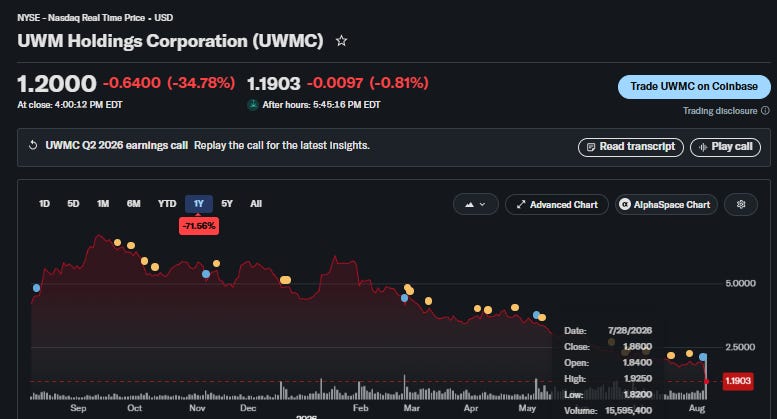
Talk about deja vu. Servicing costs and pipeline hedging losses can be papered over with origination of more loans or acquisitions. UW is blaming a failed acquisition on its loss. Without their 10Q, I cannot tell you exactly what happened, but I can tell you that nothing good is coming for mortgage any time soon. These nonbanks are in for a world of hurt as these servicing costs increase. Rocket also just reported. Despite seeing an increase in revenue and market share (won’t be good later), the stock is down in after-hours trading. Once I get both of their 10Qs, I will do a post charting what’s next for these nonbanks.
But for today, I will walk you through an example haircut for an asset in TN which just sold at a foreclosure auction. I will also provide the lists of cities where we saw motivated, distressed and depressed selling in June. This week’s post also includes top 5 city summaries for sales, prices, listings, delistings and days on market as well as insights into cities where we are seeing sales increasing and decreasing. Lastly, I will share my latest piece on the state of commercial real estate which discusses the biggest risk pension funds currently face.
Let’s rock and roll…
