
Buckled Beams

When I saw the headline about the building at the center of a large office-to-apartment conversion in New York City whose beams buckled, I thought that this could become one of the most poignant memes of the cycle. Layer on the fact that the building was previously occupied by Pfizer and you couldn’t get a much more illustrative representation of Covid fever dreams collapsing under the weight of their own feverishly fabricated narrative.

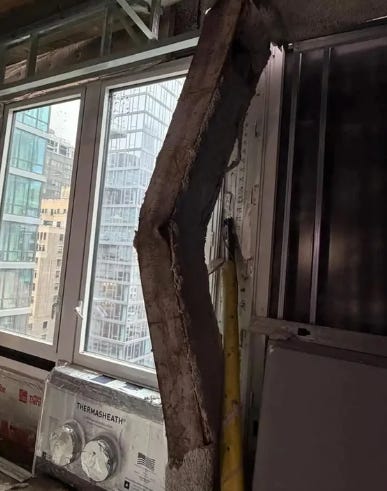
The ambitious project aims to transform the former Pfizer headquarters complex in Midtown into roughly 1,600 apartments, along with a rooftop pool, fitness center and ground-floor shops. It is expected to be completed next year and is the largest ever office-to-residential conversion in the country.
The developer said the increased weight from the widening of about 15 top floors—starting on the 22nd floor—caused the structural damage.
Mamdani said Wednesday that he still considered office-to-residential conversions to be part of the answer to the city’s housing crisis—but emphasized that such conversions must be done safely.
Forget that there are anywhere from 50-100K apartments being held vacant in NYC due to the passing of a law in 2019 which capped how much owners of rent stabilized apartments could raise rent for capital improvements. An insignificant detail of course, she says sarcastically. Landlords cannot afford to bring these apartments up to code, so they have chosen to let them sit vacant. Let’s for sure power forward on a ridiculously expensive and complex development project which makes little architectural sense instead of actually trying to utilize the existing stock and solve our housing problems that way. Makes perfect sense when you understand it’s not about solving problems but feeding the debt markets and satiating Wall Street’s never-ending appetite for fat fees.

As first responders raced to the scene, a developer, Michael Pestronk of Post Brothers, “had just finished pitching investors on a slate of new real-estate conversion projects on Tuesday, when he noticed five missed calls,” leading him to worry that lender interest would cool on conversion projects. Multiple locations on the block were evacuated, including a Hampton Inn, leaving tourists stranded. Temporary beams have now been placed on floors 18-23 at 235 East 42nd St. to shore up support and prevent a collapse. MetroLoft, the developers on this project, dove into this particular virtue-signal fantasy with both feet.
The past half-decade has been a boom time for office-to-residential conversions. At the start of this year, about 90,300 units from office-to-apartment conversions were in the pipeline across the U.S., up 28% from a year earlier, according to the apartment search website RentCafe.
New York City leads the way with 16,358 office-to-apartments in various stages of development, nearly double compared with the year before.
Private developers see conversions as a potential way to cut down on the ballooning costs of building from scratch. Public officials like the win-win: It addresses both their housing shortages and the overhang of empty office space plaguing downtowns (my emphasis).
While many of these office buildings sit empty, developers continue to build new office buildings, adding to the already over-built office stock. In New York City in particular those empty apartments which could be a solution to the so called “housing” shortage are staring them straight in the face. The only reason the solutions aren’t obvious is because the incentives are not there and the maze of red tape is Soviet-style absurd. Instead, we are left living in some dystopian reality where logic has exited stage left.
When I wrote my article for HousingWire in January of 2023 I mentioned the office-to-apartment phenomenon as a potential driver of increased inventory, albeit delayed. What I did not realize back then is just how long these themes take to play out.

Let’s do a quick pulse check as to where we are with each of these themes. With respect to the Airbnb bust that has been ongoing since late 2022, lending has only increased in this area despite owners falling on hard times. Just as the industry should have been pulling back from this space and non-qualified mortgage lending which includes debt service coverage ratio loans, they are falling all over themselves trying to capture the volume.

Why? The securitization machine is a Ponzi scheme, so they need an endless supply of product to keep it going and “mask” other declines. Soon, the expense side is going to raise its hand due to increasing defaults and mandatory repurchases. You see, in this game, when the stuff hits the fan, the entity left holding the bag, turns to the entity behind them and says no way, Jose. You have to buy this back for x, y and z reason. There are always reasons because the technology, process and people in this space would make Bartleby, the Scrivener look productive. Due to the way the system is constructed, there is usually someone behind you. The smaller lenders who then deliver their loans to correspondents who sell those loans to the agencies will get smoked. I’ve already seen it happen.
For a real-world example of Airbnb motivated selling, take San Diego. I was told over and over and over on social media that sales prices would never come down there due to the large military presence. Then I made a little visit and begged to differ. From the time period of my visit, a snapshot of the Airbnb infestation in San Diego from Inside Airbnb:
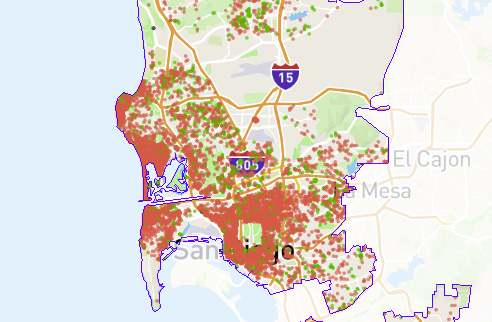
At the time, Inside Airbnb showed on their map 12,346 short-term listings. Per Redfin, median sales prices were down in May -2.98% YoY. Many short-term operators who could not sell properties listed them for long-term rental instead. Since June of 2024, listings for rent in San Diego have increased by 20% and listings for sale have increased by 46.86%. According to AirDNA occupancy sits at 57.4%, down from 63.7% in June of 2024. Remember, those loans were underwritten to the “optimistic” view of occupancy that you can find in the AirDNA platform. Just wait until we say goodbye to the World Cup on July 19th.
For theme #2, look no further than Vinebrook to see fire-selling on the institutional investor side.

Vinebrook, who owns 20K+ single-family rentals, is by no means alone. I had the opportunity to be in a closed-door conference session with one of the largest institutional investors last September. At the time, I was told they were rehabbing as soon as leases were up and selling as fast as possible in most markets.

For theme #3 regarding robust, new construction with motivated selling, please see last week’s post. Builder motivated selling will increase into the fall and beyond.
With respect to boomer second homes, I believe they comprise a good portion of the rage delisting we have seen across the country. As you are aware based on recent shared stats, delistings in May as a % share of listings hit almost 10% on average for the cities I track…in the selling season which ended 9 days ago. There’s no way to tell at the moment, but I’m ever in search of new data. Those who have delisted are not in a relative hurry to sell as the stock market hovers around record highs. Almost every week I meet a retiree who is fully invested in the stock market. Sigh. The AI narrative recently took another hit when OpenAI delayed its IPO and Alex Karp went on CNBC slamming the frontier models. Watch out, San Fran. The mania that has taken hold of the housing market there is about to punch some folks in the mouth.
Of course, the fifth theme regarding office-to-apartment conversions is mentioned above. Our sixth and final theme is our challenged demographics.

Not only is household growth slowing due to affordability challenges and slowing wage gains, the largest group of homeowners is also growing older with aging-related household dissolutions “poised to increase dramatically. The cohort of householders age 65 and over in 2025 is projected to shrink by 1.4 million annually between 2025 and 2035” compared to 1.2 million between 2014 and 2024, an increase of 16.67%. One of the reasons this trend takes time to understand is just how long these properties can be tied up in the probate process. I recently went to an auction with a friend for a property where the owner had been deceased for three years. Immigration also worked to slow down wider recognition of our demographic problems, leading many to believe those population gains were due to relocations versus immigration. The Harvard study notes that “the share of households that have relocated in the past 12 months fell to 11.2 percent in 2024, according to the Census’ American Community Survey (ACS), lower than any point in the 20-year history of the survey.” People may want to move but many simply cannot afford it.
Speaking of immigration, I’ve seen the recent headlines claiming that immigration specifically led to large increases in home prices. I think the issue is nuanced and should be studied regionally. The Dallas Fed paper behind the headlines is more subtle. Until I can access reliable data, I will not be commenting.
This is where we were before we received existing home sale results today. With the publication of June existing home sales, the U.S. selling season has come to an unceremonious close. Wow, what a dud this season has been (again).

With rates averaging much lower than this time last year, 6.27% through June this year versus 6.81% through June last year, we should be seeing higher sales. The small gains we have seen YoY have been muted even with the stock market hovering around all-time highs. Existing home sales for June of 2026 came in the lowest since 1999 behind 2008, 2024 and 2025. Below I will share details as well as my thoughts to what’s next for both sales and prices. Additionally, we will put a pin in May with the top 5 city summaries for sales, price, inventory, days on market and delistings as well as lists of cities where we are seeing motivated, distressed and depressed selling. With each passing month new and interesting names are making it to these lists, including cities in regions which are supposed to be just fine. 23 cities showed signs of motivated selling (sales up YoY, but prices down) compared to 8 cities last year. You may recall that overall, 33 of the cities I track had YoY price declines in May versus 26 markets last year, including 13 of the 29 markets I track with populations over 500K. Just so you know it’s not just the cities I track. According to the Harvard study cited above, 41 of the 100 largest markets showed YoY declines in February 2026 compared to 9 in 2025. The JCHS noted that even in the markets that are seeing appreciation that appreciation has dropped below the rate of inflation in most of them. No matter how loud the chorus, home price appreciation is transitioning to home price depreciation with no end in sight considering the above themes. Finally, I will share two of my commercial real estate posts this week: my most recent on Scott Everett’s $400M wipeout of its first multifamily fund as well as a post written earlier this year regarding a new office tower in New York City with, funnily enough, Pfizer as its anchor tenant. The Spiral, a 66-story, 2.84 million-square-foot office building located in Hudson Yards is Pfizer’s new home after selling the location featured above. This property is the sole asset in a rather large securitization. Nothing to see here, folks. As we near the end of the cycle more and more of these stories will be crossovers from previous stories. As discussed here often, commercial and residential real estate are inextricably linked.
Without further ado…
